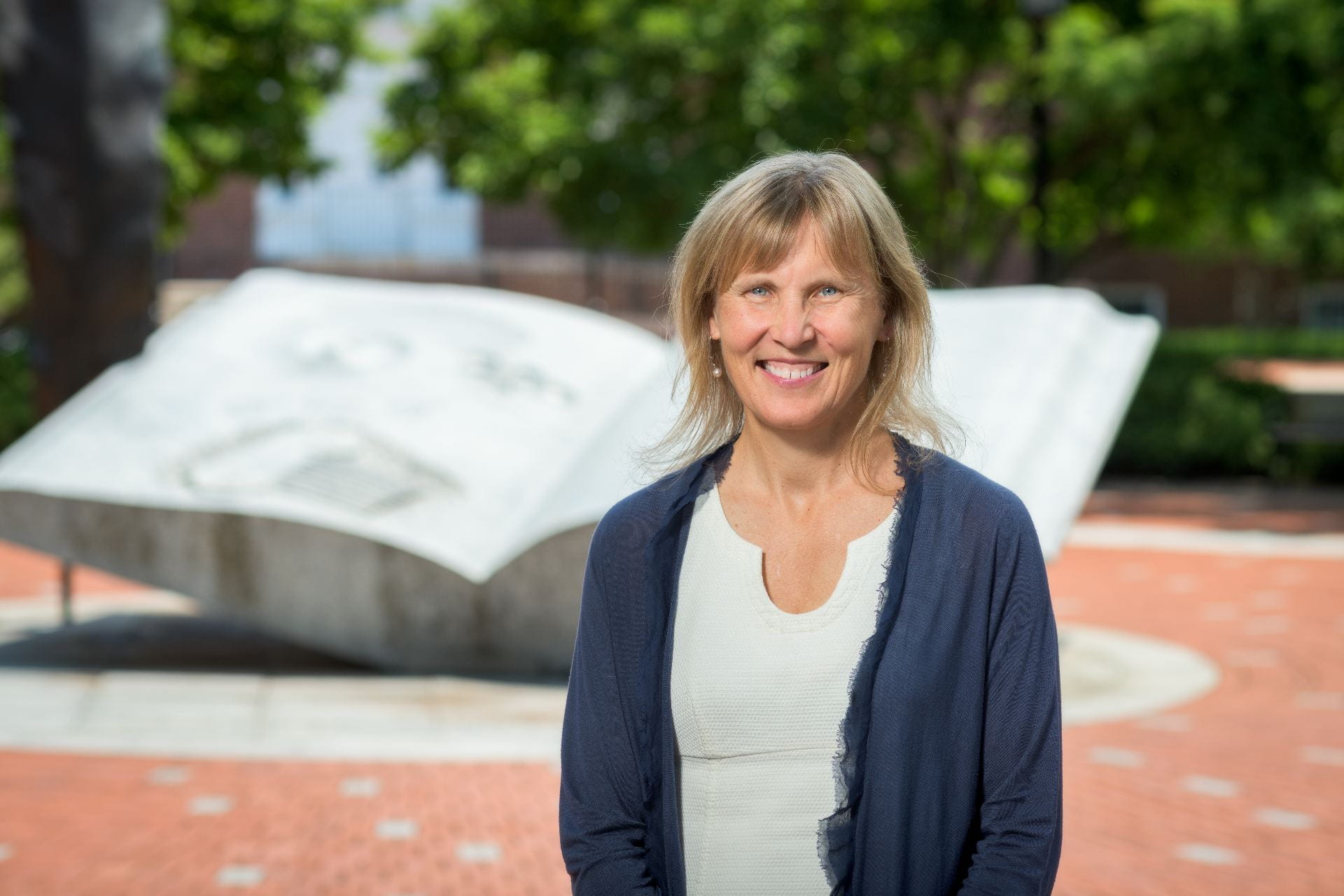
Welcome to the Office of the Provost! As the chief academic officer of the University, the Provost is responsible for the administration of all programs of instruction, research, and service, and for facilitating the success of the University's faculty and students. The deans of the seven colleges report directly to the Provost as do the Deputy Provost, the Senior Vice Provost for Research, the Vice President for Student Life, the Vice Provost for Graduate and Professional Education, the Vice Provost for Libraries, the Director of Museums, and the Associate Provost for Enrollment Services.
We invite you to follow the many links from our site to learn more about our office, its personnel, and the University of Delaware's seven colleges, including departments, programs, research, faculty and administrators.

Interim Provost: Nancy Brickhouse
Email Address: nbrick@udel.edu
Bio: NBrickhouseBio.docx
Vita: NBrickhouseCV.doc
Archived Newsletters (*.doc)
June 2013
March 2013
January 2013
November 2012
September 2012
August 2012
Online Education Task Force Report (*.pdf)
December 2012

June 2013
Dear Colleagues,
Spring 2013 has drawn to a close. We celebrate with graduation and convocation ceremonies, as well as with Alumni Weekend. I hope you were able to visit with former students to catch up on their accomplishments and to engage them in the ongoing activities at the University. We have much to brag about: Our scholarship is making an impact on the world and our students are thriving. However, engaging our alumni will make us stronger by their contributions of time, by opening doors for our students, and by their gifts.
The end of the semester also brings important news regarding the faculty governance and support for faculty research.
New Collective Bargaining Agreement
After a semester of intense negotiations between the administration and the UD AAUP, we now have a new contract for 2013-2016. We covered a lot of territory with this contract—online compensation, administrative searches, stop-the-clock processes, workload agreements, and, of course, compensation. The best summary of the changes may be found on the AAUP website. The final document can be found on the Provost website under the Resources tab.
The primary goal of the administration throughout the negotiations was to assure our ability to support faculty innovation, especially in regard to teaching. I believe you will find that this Collective Bargaining Agreement (CBA) allows for more discernment and decision-making at the department level—where faculty workloads are negotiated. In listening to my colleagues in the AAUP, it seemed to me that their primary concern was to assure the strong voice of the faculty in matters of critical importance to the University. Thus, you will find some changes in the CBA in areas such as administrative searches, program elimination, and conditions of employment.
I want to thank the two teams for their dedicated service. For the administration: Stuart Binder-MacLeod, Tom LaPenta (chief negotiator), Nancy Targett, George Watson, and Bruce Weber. For the AAUP: Theodore Davis, Kevin Kerrane, Beth Morling, David Smith, and Gerry Turkel (chief negotiator).
Faculty Handbook Update and Senate Business
After years of trying to navigate an unmarked and oddly organized Handbook, we have a new online version. This new version is fully indexed with changes dated. Special thanks to John Madsen, Joe Kempista, and Joan Stock for their work on this.
This new Handbook format makes it much easier to track changes approved by the Senate. For example, the Senate passed a resolution requiring more explicit reporting requirements for the process of selecting external review letters for promotion and tenure. The Senate also approved a new online policy that is consistent with the recommendations of the Provost Task Force on Online Learning. Both of these changes can be found in Handbook Updates.
One issue that has created considerable challenges is that the Handbook includes a lot of information that is not academic, e.g. information about benefits. Likewise, the CBA currently contains policies that ARE academic, and arguably the purview of the Faculty Senate. One outcome of collective bargaining is a letter of understanding that will require us to sort out what issues are academic—and thus ought to be in the Faculty Handbook—and what are conditions of work—and thus ought to be negotiated and included in the CBA.
Building Research Capacity in the Behavioral Sciences
On 9/30/11, former Provost Tom Apple charged a faculty committee (led by Greg Miller, Chair, Department of Psychology) to develop a 10-year vision for Magnetic Resonance Imaging (MRI) at UD, and a strategic plan for implementing that vision. The Task Force was charged to prepare a report describing the facilities needed for state-of-the-art research programs, priorities and plausible pathways to develop the needed capabilities, estimates of the costs and likely sources for funding, possible locations for instruments, and the construction/renovation needed to implement the plan. In October 2012, the Task Force presented its plan to Vice Provost Charlie Riordan and me. Their recommendations include a two-machine MRI center.
In response to the Task Force recommendations, we are proceeding with the construction of a two-instrument center, an extension of the Life Science Research Facility. Initially, it will contain a single 3 Tesla system suitable for human, animal, and materials imaging. Budget projections indicate that user fees can sustain the operations of this facility. The Executive Vice President, the Provost, the College of Arts and Sciences, and the College of Engineering will support start-up costs.
The faculty support for building this facility has been overwhelming. The capability for visualizing the internal structures of materials, both living and nonliving, is a core capability in many fields of study, from behavioral economics to neuroscience to agriculture to physical therapy to materials science. Essentially, all seven colleges potentially can benefit from this MRI facility.
Tatyana Polenova and Bob Simons have agreed to co-chair the Task Force moving forward. Other members include Stuart Binder-MacLeod, Tom Buchanan, Dawn M. Elliott, Peter Krawchyk, Christopher M. Modlesky, and Chad E. Forbes.
Wishing you a productive summer.
Regards,Nancy
Interim Provost